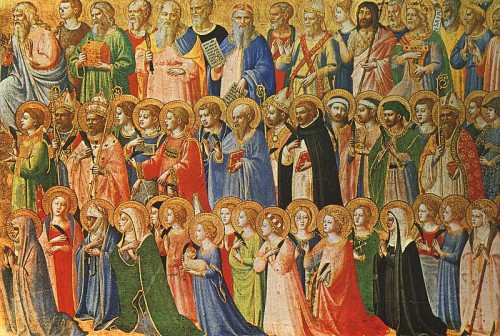
Today, November 1st, the feast of All Saints is a distinctive day in our Catholic list of feast days. The Church has a very precise process, called canonisation through which it feels confident to say that somebody has lived a life in tune with the will of God and has now reached the kingdom of heaven.
However the Church knows too that we can’t limit the number of people who have reached eternal happiness in continuation of their holy Christian lives. They are people known to us – family, friends, colleagues and people like ourselves who have helped the thirsty, the hungry, those without clothes and shelter. The love of neighbour that, after our death leads to God’s right hand. These were the gestures that carried weight with Jesus.

The Book of Revelations
“After this I had a vision of a great multitude, which no one could count, from every nation, race, people, and tongue. They stood before the throne and before the Lamb, wearing white robes and holding palm branches in their hands. They cried out in a loud voice: “Salvation comes from our God, who is seated on the throne, and from the Lamb.”” (Rev. 7:9-10)
The feast of All Saints is a day of great hope and inspiration for us. As the Epistle to the Hebrews states “since we are surrounded by so great a cloud of witnesses, let us rid ourselves of every burden and sin that clings to us and persevere in running the race that lies before us.” (Heb. 12:1)
Mass attendance
A holy elderly priest was once asked “how many people attended the early morning Mass today”?
He responded “There were three old ladies, the janitor,
several thousand archangels,
a large number of seraphim,
and several million of the triumphant saints of God”.
But we always have room for one more!
We should always keep in mind the great cloud of witnesses that surround us at every Mass.
So on this feast we remember the many good people gone before us whom we’ve met in life and without embarrassment pray to them to help us on our journey. May we join them one day in the communion of saints.
All Saints’ Day is also also known as All Hallows, Day of All the Saints, Solemnity of All Saints, or Feast of All Saints. It is a solemnity celebrated by the Catholic Church and various Protestant denominations in honour of all the saints, known and unknown. In Catholic theology, the day commemorates all those who have attained the beatific vision in Heaven.
*The ultimate object of the veneration of the saints is the glory of God by celebrating the the lives of those who were pre-eminent disciples of the Lord we celebrate God’s influence in our lives.
In the Western Church: In the early days the Christians were accustomed to solemnize the anniversary of a martyr’s death for Christ at the place of martyrdom. In the fourth century, neighbouring dioceses began to interchange feasts, to transfer relics, to divide them, and to join in a common feast; as is shown by the invitation of St. Basil of Caesarea (397) to the bishops of the province of Pontus. In the persecution of Diocletian the number of martyrs became so great that a separate day could not be assigned to each. But the Church, feeling that every martyr should be venerated, appointed a common day for all. The first trace of this we find in Antioch on the Sunday after Pentecost. We also find mention of a common day in a sermon of St. Ephrem the Syrian (373), and in the 74th homily of St. John Chrysostom (407). At first only martyrs and St. John the Baptist were honored by a special day. As early as 411 there is in the Chaldean Calendar a “Commemoratio Confessorum” for the Friday after Easter.
On 13 May 609 or 610, Pope Boniface IV consecrated the Pantheon at Rome to the Blessed Virgin and all the martyrs, ordering an anniversary; the feast of the ‘dedicatio Sanctae Mariae ad Martyres’ has been celebrated at Rome ever since. There is evidence that from the fifth through the seventh centuries there existed in certain places and at sporadic intervals a feast date on 13 May to celebrate the holy martyrs.
A November festival of all the saints was already widely celebrated on 1 November in the days of Charlemagne. It was made a day of obligation throughout the Frankish empire in 835, by a decree of Louis the Pious, issued “at the instance of Pope Gregory IV and with the assent of all the bishops”, which confirmed its celebration on 1 November. The octave was added by Pope Sixtus IV
The feast of All Saints achieved great prominence in the ninth century, in the reign of the Byzantine Emperor, Leo VI “the Wise” (886–911). His wife, Empress Theophano – commemorated on 16 December – lived a devout life. After her death in 893, her husband built a church, intending to dedicate it to her. When he was forbidden to do so, he decided to dedicate it to “All Saints”, so that if his wife were in fact one of the righteous, she would also be honored whenever the feast was celebrated. According to tradition, it was Pope Leo who expanded the feast from a commemoration of All Martyrs to a general commemoration of All Saints, whether martyrs or not….
